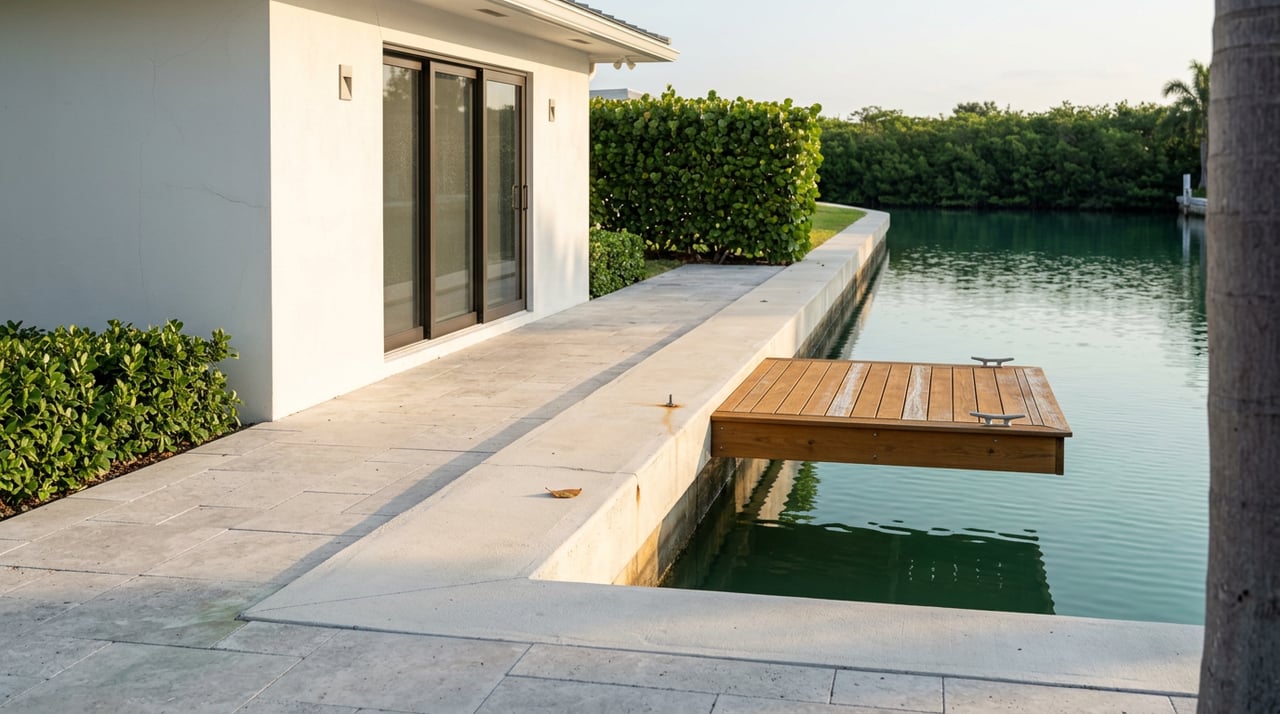
Two homes on the same finger canal in Rio Vista, listed within a month of each other, both with seawalls poured in the same decade. One buyer closes in six weeks. The other spends four months in underwriting because an inspector flagged the same kind of hairline crack the first buyer's contractor called cosmetic. The crack wasn't the difference. A single word in the city's code was: substantial.
Most buyers walk into a Fort Lauderdale waterfront showing thinking about the seawall the way they think about a roof: something to inspect, maybe negotiate a credit for, then move past. That assumption works in most of the country. It does not work as cleanly here, because Fort Lauderdale already enforces a higher elevation standard than most of Broward County has to meet for another decade, and the line between "repair" and "replace" is the fact that decides which side of that standard your transaction lands on.
The City Moved First
Since March 2023, Fort Lauderdale has required new and substantially repaired seawalls to reach 5.0 feet NAVD88, under the city's own tidal barrier ordinance. That's not a future date. It's the standard being enforced on permit applications right now.
Broward County's own resiliency code gives most of the rest of the county more time to get there: a 4.0-foot NAVD88 minimum by January 1, 2035, and 5.0 feet by 2050. Fort Lauderdale simply didn't wait for the county timeline. If you're comparing a canal-front listing inside city limits to one just over the line in an unincorporated part of the county, you're not comparing two properties under the same rule. You're comparing one that already has to meet the 2050 number against one that has until 2035 just to reach 4 feet.
That gap changes what "the seawall looks fine" actually means depending on which side of a city boundary the dock sits on, and it's the reason a Fort Lauderdale address carries a different underwriting conversation than a nearly identical property a few blocks away.
Where Repair Turns Into Replace
Here's the part that surprises people mid-contract. A seawall repair doesn't stay a repair just because a contractor calls it one. Broward's resiliency code, described consistently by permit specialists who handle these applications for a living, sets a threshold: once work affects more than half the length of a seawall, or the cost of that work exceeds half the value of the flood barrier itself, the project becomes a substantial repair by definition. A substantial repair has to meet the full current elevation standard, not just patch what was already there.
That single definition is why two homes with similar-looking cracks can require completely different scopes. A wall needing 40 feet of work on a 100-foot lot might stay under the threshold and only need that section fixed. The same lot needing 55 feet of work crosses the line, and now the entire 100 feet has to come up to 5.0 feet NAVD88, not just the damaged part.
Three Bids, Three Very Different Numbers
Ask three marine contractors for a quote on the same wall and expect three different scopes, because the failure mode drives both the price and how close the project sits to that 50 percent line. One 2026 marine construction cost breakdown separates the two outcomes clearly:
| Scope | Typical Cost | What Drives the Price |
|---|---|---|
| Targeted repair (tieback, toe scour, panel patching) | $100–$600 per linear foot | Which failure mode, how much length is affected |
| Full replacement to current code | $1,500–$3,500 per linear foot | FDEP and Army Corps permitting where required, water depth, soil, access |
A separate 2026 estimate for a typical 75-foot lot put full replacement at $30,000 to $80,000 total, which works out to roughly $400 to $1,067 per linear foot, well below the marine contractor's replacement range above.
That spread is the point. The number you write into a contingency for a Fort Lauderdale seawall isn't a fixed line item the way a roof estimate usually is. It depends on failure mode, access, and whether the project crosses the substantial-repair line, which is exactly why one bid isn't enough before you write an offer around it.
The Same Rule Plays Out Differently by Canal
Fort Lauderdale is called the Venice of America for a reason. The city owns roughly six miles of canal inside its limits. Private property owners are responsible for the other 254 miles of waterfront. That means how this ordinance actually surfaces in a transaction depends heavily on which canal you're standing on.
- Rio Vista's housing stock ranges from 1950s ranches to recent custom builds on the same block, so seawall age and permit history can vary lot to lot. A current survey referencing NAVD88 is worth ordering before you write an offer, not after.
- Harbor Beach's private road infrastructure has kept its seawalls in more uniform condition over the years, since upkeep tends to get managed collectively rather than lot by lot.
- Las Olas Isles' newer deep-water canals can accommodate vessels up to 60 feet, which raises the stakes on wall and dock condition, since the buyer pool for a compromised deep-water lot is smaller and more particular about it.
- Sunrise Key sits squarely inside the current NAVD88 conversation, with homeowners there actively working through compliance questions as walls come up for repair, sale, or refinance.
- Coral Ridge's wide, navigable canals put a premium on dockage, so a non-compliant wall doesn't just mean repair dollars. It can shrink the pool of buyers willing to finance the boat they actually want to keep there.
None of this makes one neighborhood a better or worse buy than another. It means the seawall conversation starts from a different place depending on the address, and a general answer about waterfront condition in Fort Lauderdale isn't specific enough to act on.
What a Lender Actually Does With a Non-Compliant Wall
This is where the ordinance stops being a permitting question and becomes a financing one. When an appraiser encounters a seawall below the current standard, three things typically happen. The appraiser calculates a cost-to-cure based on contractor estimates. The property may get flagged for functional obsolescence if the condition limits usability or narrows the buyer pool. And comparable sales get harder to use cleanly, since a recent comp with a compliant wall isn't a fair match for a listing that still needs six figures of work.
Lenders can request documentation before closing: elevation certificates, a marine inspection report, and proof that any needed work is complete or permitted with a defined timeline. Some will hold funds in escrow for a known, near-term project rather than declining the loan outright, which is often the difference between a deal that survives underwriting and one that doesn't.
How These Deals Actually Get Closed
When a seawall isn't yet compliant, buyers and sellers in Fort Lauderdale generally reach for one of a handful of structures instead of walking away:
- Price credit equal to cost-to-cure, plus a reasonable buffer for permitting uncertainty.
- Seller completes the work before closing, though this requires time most sellers don't have, since permits across Broward County commonly take three to four months once engineering and environmental review are factored in.
- Escrow holdback, where funds are held at closing and released once permitted work is finished and inspected.
- Time-bound contingency, keeping the contract open for a defined window while a permit or variance works through the city.
None of these are exotic. They're standard tools that only work if both sides know the true scope early, which means ordering the marine inspection and the NAVD88 survey before the standard fifteen-day inspection period closes, not during it.
What the Contract Already Asks You to Disclose
Florida's standard residential contract requires sellers to disclose facts that materially affect a property's value and aren't readily observable to a buyer. A seawall sitting below the current elevation standard fits that description, and Fort Lauderdale's own ordinance goes further by requiring disclosure language specifically for tidally influenced properties. If you're selling, the safer move is documenting the wall's condition and elevation before you list, rather than waiting for a buyer's inspector to raise it first.
A Few Questions Worth Asking Before You Write an Offer
Does every waterfront home in Fort Lauderdale need a new seawall right now? No. The 5.0-foot standard applies to new construction and to walls undergoing substantial repair. A wall in good condition that hasn't triggered that threshold can remain as it is.
How do I find out if a specific seawall complies? A current survey referencing NAVD88, paired with an inspection from a licensed marine contractor, is the reliable way to know. A standard home inspection typically doesn't cover this.
Who pays if the wall isn't compliant? It's negotiated case by case, usually through one of the structures above. There's no default rule that automatically puts the cost on either buyer or seller.
Waterfront property in Fort Lauderdale rewards buyers and sellers who understand exactly where their canal sits in relation to this code, not just what the listing photos show at high tide. If you're weighing a purchase or a sale on the water here, from Rio Vista to Sunrise Key to the newer construction rising along Las Olas Isles, a conversation before you write or accept an offer costs nothing and can save both sides months of underwriting surprises.
Linda Faille-Roy has spent two decades working Fort Lauderdale's waterfront corridor and can walk you through what a specific seawall, dock, and canal history actually means for your transaction, in English or in French. Schedule your bilingual concierge consultation today.