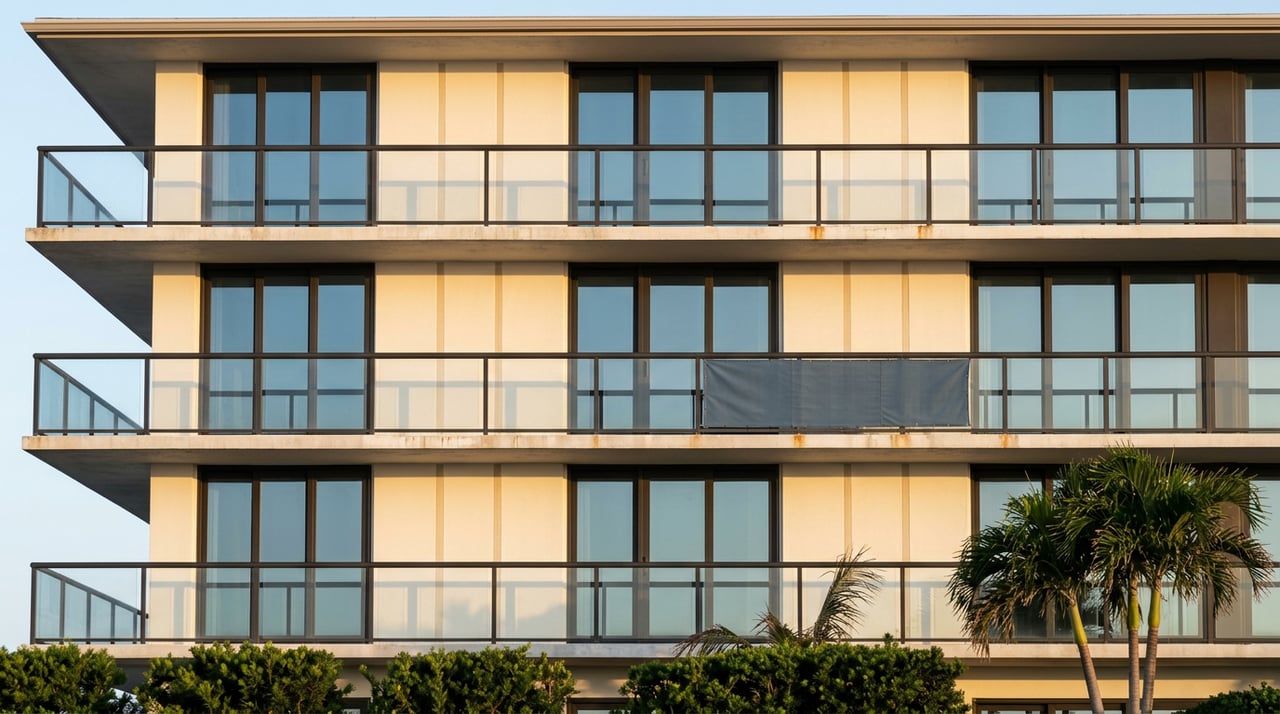
Two towers, same stretch of Collins Avenue, same 2-bedroom layout, same rough price per square foot. One quotes a monthly HOA fee of $850. The other quotes $1,450. Most buyers walking these two units back to back would treat the cheaper fee as the win and file the pricier one away as "overpriced association." In Sunny Isles Beach in 2026, that instinct is backward more often than not.
The reason has nothing to do with amenities, staffing, or how recently the lobby was renovated. It has to do with a paperwork deadline that's closing in on a large share of this city's condo stock right now, and a fee that looks generous today can be the clearest sign that the bill hasn't arrived yet.
Two clocks, one calendar
Miami-Dade County has required buildings to recertify their structural and electrical systems since an ordinance passed in 1975. That ordinance originally set the trigger at 40 years, and the term "40-Year Recertification" still gets used around older buildings for that reason, but the standard administered today through Sunny Isles Beach's own building department follows the Florida Building Code, which now calls for recertification once a building turns 30 and every 10 years after that. Either way, this clock has been running quietly in the background for decades and mostly gets handled the way roof replacements do: an assessment here, a special line item there, rarely a headline.
The second clock is newer and louder. After the Champlain Towers South collapse in 2021, the state passed a milestone inspection and Structural Integrity Reserve Study requirement for condo and co-op buildings three stories or taller. That law has been amended twice since, most recently by HB 913 in 2025, which pushed the Structural Integrity Reserve Study deadline and, for buildings whose milestone inspection also comes due around the same time, allows both to be completed together, but no later than December 31, 2026.
What makes this year different from the ordinary rhythm of recertifications is that both clocks are converging on the same 12 months for a meaningful slice of Sunny Isles Beach's older buildings. A structural report that would normally have quietly become an assessment notice in a mailbox is now paired with a state-mandated funding study that a board can no longer wave off with a vote.
Why Sunny Isles doesn't get the 30-year grace period
The Florida Department of Business and Professional Regulation's own guidance shortens the first milestone inspection from 30 years to 25 for buildings in areas where local conditions, meaning salt air and coastal exposure, warrant it. Sunny Isles Beach sits on a barrier island between the Intracoastal Waterway and the Atlantic, which puts nearly its entire condo inventory inside that accelerated window rather than the standard one.
That detail matters because of when this city was actually built. Sunny Isles Beach spent decades as a strip of low-rise motels before it incorporated as its own city in the late 1990s and rezoned for the glass towers that now define its skyline. A lot of the mid-rise and early high-rise stock along Collins Avenue and the streets running to the Intracoastal dates to the 1970s through the 1990s, which puts a meaningful number of buildings squarely into the 30-year, 40-year, and 50-year recertification range at the same moment the newer state law is asking harder questions about how well-funded their reserves actually are.
Not every aging building here follows the same path. The Miami Beach Club, a two-story, 108-unit building completed in 1951, was sold in 2025 for roughly $131.8 million to a development group that has since won city approval to replace it with a 62-story tower. That's one way an old building's story ends: a developer buys the land under it and the recertification question becomes moot. Most owners in most buildings don't get that outcome. They get the inspection, the reserve study, and whatever it says their building actually needs.
The document you can now legally ask for
Here's what changed in the buyer's favor. Florida's HB 1021 requires associations with 25 or more units to post governing documents, budgets, and reserve studies to a website or app, a requirement that took effect January 1, 2026. Practically, that means a prospective buyer can request the completed Structural Integrity Reserve Study and milestone inspection report for a specific building before signing anything, not just take the seller's word that "everything's fine."
That request should be as routine as asking for the seller's disclosure. Two documents tell you almost everything the monthly fee doesn't:
- The Structural Integrity Reserve Study, which lays out what major components (roof, load-bearing elements, waterproofing, electrical, plumbing, fireproofing) need repair or replacement, when, and at what projected cost
- The milestone inspection report, which states whether the building shows substantial structural deterioration and, if so, whether it's moved from a Phase 1 visual review into a Phase 2 engineering deep-dive
Here's roughly what those two phases run, based on current engineering-industry pricing for South Florida coastal buildings:
| Step | What it involves | Typical cost |
|---|---|---|
| Phase 1 milestone inspection | Visual review of structural condition | $8,000 to $25,000 for smaller buildings, $50,000 to $150,000 or more for large high-rises |
| Phase 2 (only if Phase 1 finds deterioration) | Destructive and non-destructive testing to confirm the extent of the problem | $40,000 to $250,000 or more |
| Missed deadline | Daily fine while a building stays out of compliance | $500 per day |
Those Phase 2 numbers, and any repairs they lead to, get funded through the reserves the Structural Integrity Reserve Study is supposed to have already accounted for. If they haven't been, the association levies a special assessment, and that assessment lands on whoever owns the unit at the time it's approved, not necessarily whoever owned it when the problem started.
What the low fee is actually telling you
Under the reserve funding rules now in place, associations with budgets adopted after January 1, 2025 can no longer vote to waive or underfund the reserves a Structural Integrity Reserve Study calls for, and every qualifying association had to begin funding according to its study as of January 1, 2026. That's a meaningful shift from the decades-old norm, where boards routinely kept dues low by voting to defer structural reserves year after year.
So when a building's HOA fee looks unusually low relative to comparable towers nearby, one honest explanation is that the association spent years underfunding its reserves and simply hasn't caught up yet. The new rules mean that catch-up is no longer optional, which means the fee you're quoted today may not resemble the fee, or the one-time assessment, you're looking at once the building's Structural Integrity Reserve Study is filed and the funding schedule kicks in. A higher fee at a comparable building, by contrast, can be the visible cost of a board that's already been doing the funding the old way allowed it to skip.
This is the opposite of how most buyers are trained to shop. A lower carrying cost usually signals a better deal. In a building working through 2026's compliance deadline, it can signal the opposite: a bill that hasn't been written yet.
There's a backstop, but it's built for owners, not buyers
Miami-Dade County runs a Condominium Special Assessment Program that offers qualifying owners loans of up to $50,000 to help cover the cost of a special assessment. It's a genuine relief valve, and worth knowing about if you're already an owner facing one. It isn't a reason to treat assessment risk as someone else's problem when you're the one signing the contract. The loan helps a current owner spread out a cost. It doesn't change what the building needs or when the bill comes due, and a new buyer inherits the obligation, not the paperwork trail that got the building there.
What this means if you're under contract this fall
If you're actively considering a Sunny Isles Beach condo built before the early 2000s, a few questions belong in your due diligence before you're past the contract's inspection contingency:
- Ask for the building's completed Structural Integrity Reserve Study and milestone inspection report, not a summary, the actual documents
- Confirm whether the milestone inspection found substantial deterioration and, if so, whether it moved to Phase 2
- Ask when the association's reserve funding began under its current study and what the funding schedule projects for the next five years
- If a special assessment has already been approved but not yet fully collected, confirm exactly what portion remains and who's contractually responsible for it at closing
None of this should read as a reason to avoid Sunny Isles Beach's older buildings. Many are well-managed, already through their inspections, and priced to reflect exactly that. The point is that the fee on the listing sheet was never the number that mattered most. The paperwork was.
A few questions worth asking before you sign
Does this apply to single-family homes in Sunny Isles Beach? No. Both the county recertification program and the state milestone inspection law apply to condominium and cooperative buildings three or more habitable stories tall. Single-family homes, duplexes, and small buildings under a certain occupancy load are generally exempt.
What if a building already completed its inspections years ago? Then you're simply confirming a clean record rather than an open question, which is exactly the outcome you want. Ask for the completed reports either way.
Can financing be affected if a Structural Integrity Reserve Study shows a funding gap? Lenders increasingly review a building's reserve and inspection status as part of the condo approval process, and a building carrying an unresolved Phase 2 finding or a significant funding shortfall can complicate financing. This is worth raising with your lender early, not after you've written an offer.
Buying in an older Sunny Isles Beach tower can still be one of the smarter plays on this stretch of coastline, especially if you know exactly what you're buying into before the deadline forces the building to tell you anyway. That's the kind of read a transaction needs before you sign, not after.
Linda Faille-Roy has spent nearly two decades inside South Florida's condo market, in English and in French, and knows which questions get answered honestly and which ones get deflected. Schedule your bilingual concierge consultation before you make an offer on your next Sunny Isles Beach condo.